

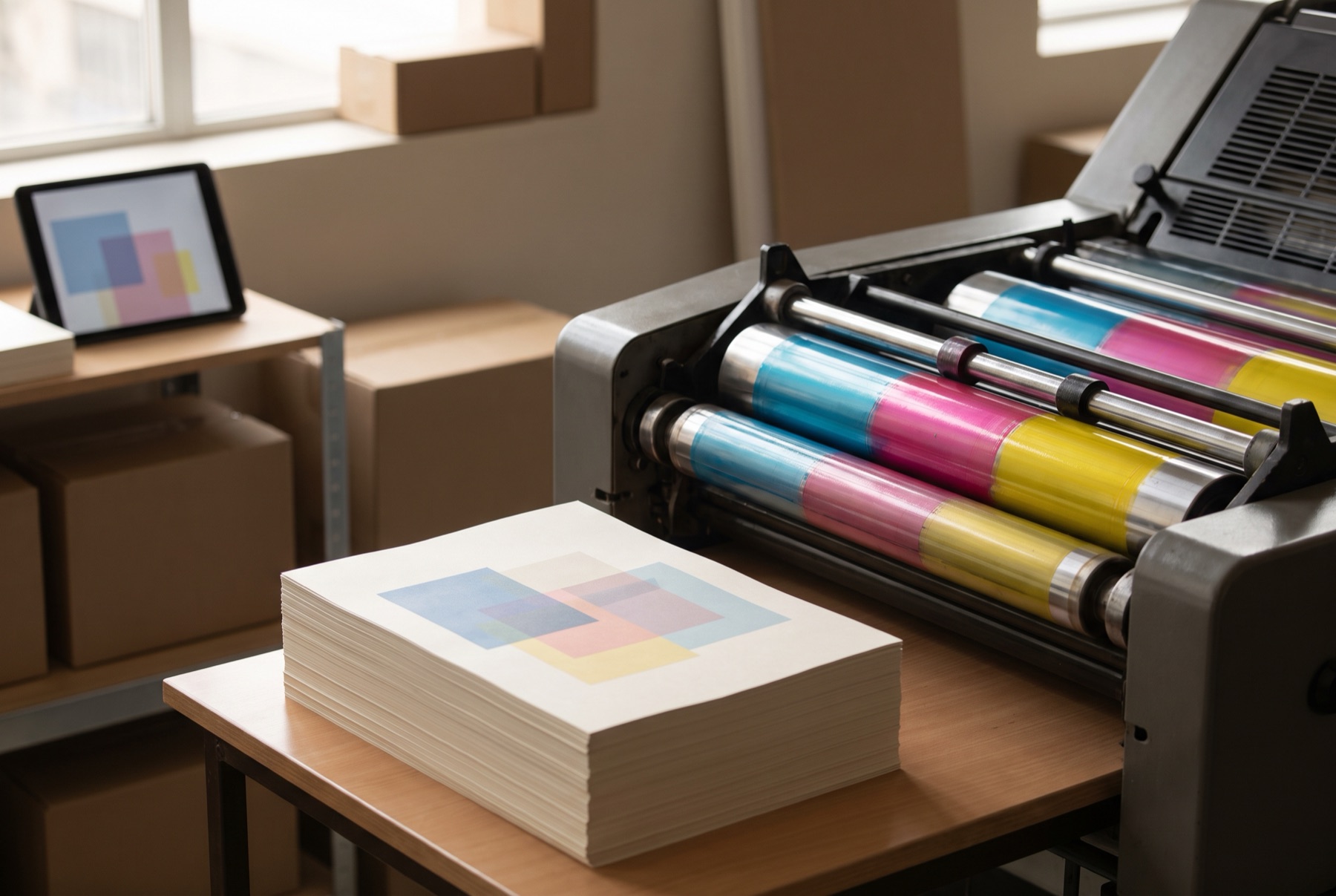
Your packaging design is only as good as its printing. The process you choose affects how colours appear, which finishes are possible, how much each unit costs and how many you need to order. Here is a plain-language guide to the main options.
Digital printing
Works like a very sophisticated office printer, printing directly from digital files without plates.
Good for: short runs, prototypes, many variations, quick turnaround.
Strengths: no plate costs, low minimums, easy to change designs, variable data like personalised labels.
Limitations: higher cost per unit at volume; some colours and special effects are harder to match.
Typical use: labels for small-batch products, early runs, limited editions.
Offset lithography
Ink is transferred from plates onto a rubber blanket and then onto the material.
Good for: medium to large runs on paper and board — cartons, boxes, printed sheets.
Strengths: excellent quality and colour accuracy, cost-effective at volume, works with spot colours and many finishes.
Limitations: set-up costs for plates; less economical for small runs.
Typical use: folding cartons, rigid box wraps, high-quality printed packaging.
Flexography
Uses flexible relief plates and fast-drying inks, common on rolls of material.
Good for: large runs on labels, flexible packaging, corrugated boxes and films.
Strengths: fast, cost-effective at high volumes, prints on many substrates.
Limitations: plate costs; fine detail and gradients can be more challenging, though quality has improved greatly.
Typical use: pouches, labels, shipping boxes, plastic films.
Screen printing
Ink is pushed through a mesh screen onto the surface.
Good for: bold graphics on glass, plastic, metal and fabric.
Strengths: thick, vivid ink; durable; can print directly onto bottles and jars.
Limitations: fewer colours practical; less suited to fine photographic detail.
Typical use: direct printing on glass bottles, cosmetic containers, tote bags.
Specialty finishes
These are often added to other processes:
- Foil stamping: metallic or coloured foil applied with heat and pressure
- Embossing and debossing: raised or recessed designs
- Spot UV: glossy coating on selected areas
- Soft-touch coatings: velvety texture
- Varnishes: matte, satin or gloss
A single well-chosen finish can elevate packaging. Kelley & Co‘s identity, for example, is specified as champagne gold foil on soft-touch black with a light deboss. The palette is defined as foil rather than ink, because flat yellow reads as a printing mistake next to real metal. That kind of detail is the difference between a good design and a good print result.
How to choose
Consider:
- Run size. Small runs favour digital; large runs favour offset or flexo.
- Material. Paperboard, labels, films, glass or metal each suit different processes.
- Design. Photographs, fine detail, spot colours, metallics.
- Budget. Balance set-up costs against cost per unit.
- Timeline. Digital is usually fastest.
Work with your printer early
Talk to your printer before finalising the design. They can advise on what will reproduce well, suggest cost savings and provide exact specifications. Always ask for a physical proof before a full run.
If you want packaging that looks as good in print as it does on screen, get in touch.