

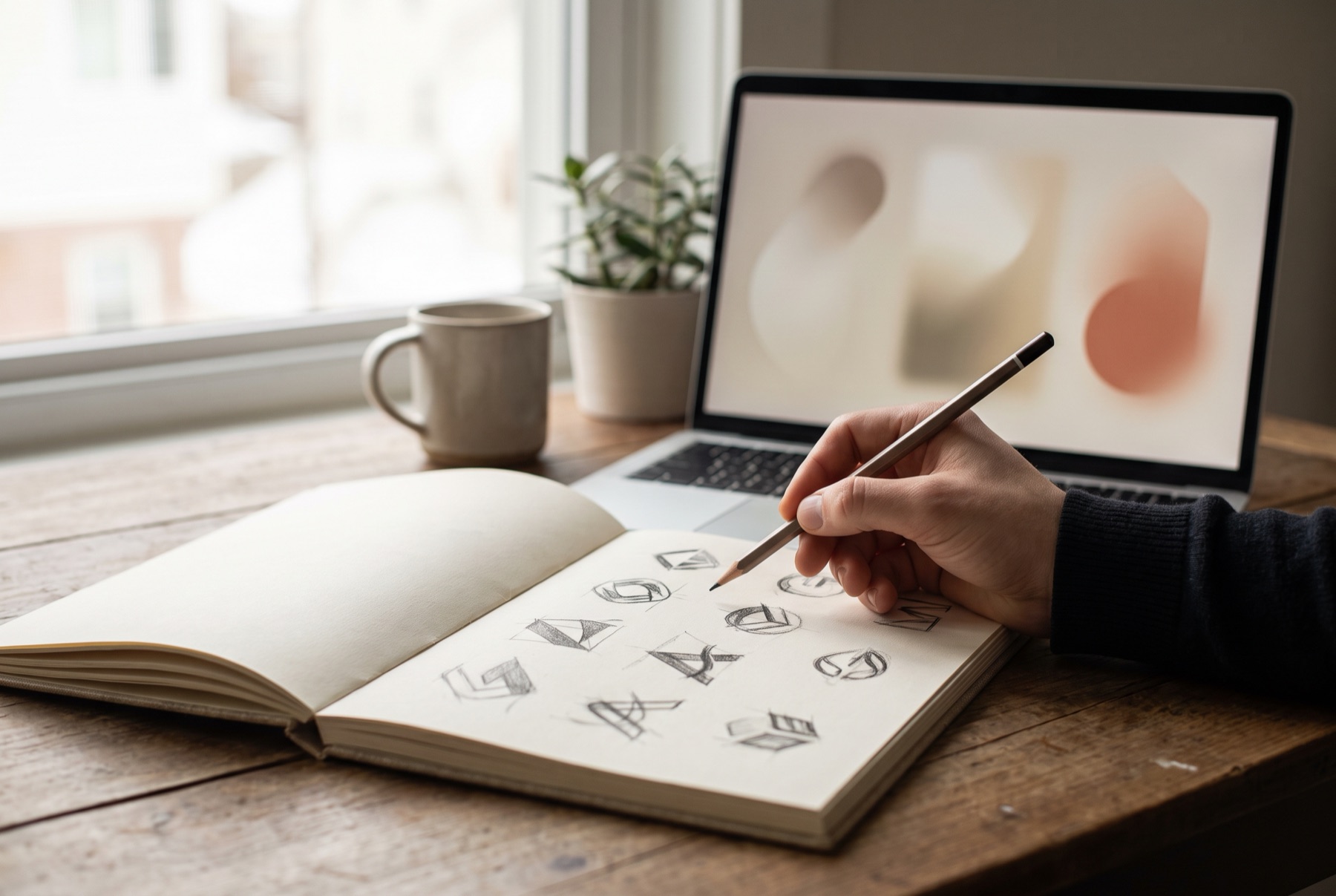
AI image and text tools have arrived in design studios fast. Some people predicted the end of design as a profession. Others dismissed the tools as toys. The reality, a few years in, is more ordinary and more useful: AI has changed how parts of the work get done, and it has not changed what makes a brand work.
Where AI genuinely helps
Early exploration. Generating rough visual directions, moods and compositions in minutes rather than days means more ideas get considered before anyone commits. That is good for clients and for the work.
Mock-ups and visualisation. Showing a packaging concept in a convincing setting — on a shelf, in a kitchen, in someone’s hand — used to require a photoshoot or hours of compositing. Now it is much faster to put a direction in context, which helps everyone judge it properly.
Production chores. Resizing, background removal, extending images, generating variations of social assets. Tasks that used to eat hours now take minutes.
Writing support. Brainstorming names, drafting variations of a tagline, tightening product descriptions. Useful as a sparring partner — rarely the final word.
What AI does not do
Strategy. AI does not know your customers, your margins, your competitors’ weaknesses or what you are actually able to deliver. Positioning — deciding what a brand stands for and who it is for — is still human judgement informed by real conversations.
Distinctiveness. Generative tools produce the average of what they have seen. That is useful for exploration and actively unhelpful for identity. A brand’s job is to be unlike its category average, and that requires deliberate choices.
Ownership. A logo or mark needs to be original, defensible and yours. Drawing a mark by hand, or building it from first principles, gives you something you can protect. Treat AI-generated marks with caution when it comes to trademarks.
Production reality. AI does not know your printer’s capabilities, your dieline, your label regulations or how a foil will behave on a soft-touch stock. Packaging that has to be manufactured still needs someone who understands manufacturing.
Taste and editing. Generating a hundred options is easy. Knowing which one is right — and why — is the job.
How to use AI well in a brand project
- Use it to widen the search, not to make the final choice.
- Treat outputs as sketches. Final assets should be built properly — vectors, real typography, colour specified for print.
- Keep the strategy human. Decide what the brand stands for before generating anything.
- Be careful with marks. Draw or construct your logo deliberately.
- Be honest. If AI imagery appears in your marketing, make sure it represents the real product accurately.
What this means for businesses hiring designers
You should expect faster early stages and more ideas to react to. You should not expect strategy, originality or production quality to come out of a prompt. The value of a good designer has moved further towards judgement: knowing what to make, why, and how to get it produced properly.
When we built the Velomelodic identity, the core idea — one continuous line that runs a waveform through a V and an M — came from thinking about what the company actually makes. No tool would have arrived there by averaging. But tools absolutely helped test that mark across plug-in interfaces, apparel and screens quickly.
That is the balance: AI for speed, people for meaning.
If you want to talk about a brand project — with or without AI in the process — get in touch.